Parrots share characteristics with certain dinosaurs that ruled the earth millions of years ago. They have short arms, beaks, and three-toed feet because birds evolved from dinosaurs.
Parrots are descended from theropods, which were carnivorous dinosaurs that appeared on Earth 200 million years ago. Over time, they grew smaller, lost teeth, and their short arms evolved into wings.
Most paleontologists consider modern birds, including parrots, “living dinosaurs.” Despite changing considerably over time, we can still identify their dinosaur-like features.
How Birds Are Related To Dinosaurs
It may be hard to look at a bird and imagine it had a ferocious, scaly, reptilian beast as an ancestor, but every bird walking or flying on Earth is descended from dinosaurs.
This includes wild birds like crows, farmed birds like chickens, and pet birds like parrots (psittacines). If it has feathers and two wings, dinosaurs are in its family tree.
Biologists often call birds “avian dinosaurs” or “living dinosaurs.”
It’s thought that birds separated from dinosaurs around 100 million years ago. Before then, birds didn’t exist, but theropods did. These were the small, carnivorous, bipedal dinosaurs from which birds evolved.
There’s evidence that birds evolved from dinosaurs. Paleontologists have examined ancient fossils and found similarities between the skeletons of dinosaurs and modern birds.
They have also discovered a transitional fossil called Archaeopteryx. This species is thought to be the oldest bird and was dinosaur-like in appearance.
Upon its discovery, it was regarded as the missing link between birds and non-avian dinosaurs.
No Common Ancestors in Birds And Dinosaurs
Because birds evolved from dinosaurs, it would be incorrect to say they share a common ancestor. Instead, dinosaurs are the ancestors of modern birds.
Specifically, birds are descended from a clade of dinosaurs called theropods.
Theropods evolved 200-250 million years ago during the late Triassic period. There were many species of theropods, but they all shared specific characteristics:
- Carnivorous. All theropods were meat-eaters, although some evolved to eat plants.
- Bipedal. All theropods walked on two legs, just like modern birds, and most theropods had shortened, clawed forelimbs used to hold fish or climb trees.
- Three-toed. Theropods had three clawed, scaly toes; most modern birds evolved a fourth.
- Feathered. Some theropods were fully feathered, only retaining scales on their feet, while others had feathers and scales to varying extents.
The best-known theropod is the Tyrannosaurus rex. This ferocious dinosaur shared a common ancestor with birds and was still walking the Earth 65 million years ago, long after birds had evolved.
Birds, like other carnivorous dinosaurs, originally evolved from theropods. Over the millennia, birds diversified into several distinct families, each with different evolutionary adaptations.
The remaining dinosaurs perished during a mass extinction.
Similarities between Birds and Dinosaurs
At first glance, birds don’t look much like how we imagine dinosaurs.
We picture dinosaurs as gigantic, scaly, ferocious reptiles with huge teeth, but the dinosaurs of “Jurassic Park” and similar recreations seem different from pet parrots and chickens.
Many dinosaurs may not have looked how we imagined them. For example, velociraptors have traditionally been depicted as having scaly skin.
More recent evidence suggests that they were feathered, like birds. Moreover, there are features that theropod dinosaurs shared with birds, including:
- Two-legged (bipedal).
- Scaly feet with claws.
- Shortened forelimbs that may have made ‘flapping’ motions.
- Warm-blooded (endothermic).
- Egg-laying (oviparous).
- At least partially feathered.
- Hollow bones.
- Wishbones (fused clavicle).
- Beak-like projections at the front of the skull, although theropods also had teeth.
- Some theropod species were carnivores, while others ate insects, seeds, or fruit.
Paleontologists believe that later theropods had similar intelligence to birds based on their skull shape and size and may have made similar sounds.
According to Evolution, some dinosaurs may have produced low-pitched, closed-mouth vocalizations like pigeons and doves.
Theropods were much larger than modern birds, and they couldn’t fly. This way, the ostrich is the most similar bird to ancient theropods.
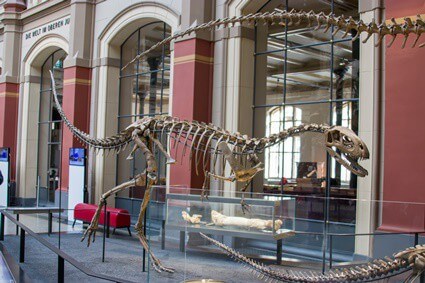
How Birds Survived The Dinosaur Extinction
At this point, you may be wondering: if birds evolved from dinosaurs, how did they survive the extinction?
Birds transitioned from theropods to avian dinosaurs around 100 – 150 million years ago.
When the Cretaceous-Paleogene extinction event occurred (66 million years ago), feathered and beaked birds existed. According to Nature, the ancestors of modern birds, like ducks and chickens, lived alongside the dinosaurs.
Paleontologists believe the mass extinction was caused by a comet or asteroid colliding with Earth. Almost all four-legged animals weighing over 55 lbs perished, except turtles and crocodilians.
All non-avian dinosaurs and large mammals were wiped out. Many other species survived, like certain birds, fish, amphibians, small mammals and reptiles, and invertebrates.
Crucially, not all birds survived. Those that survived did so because of important evolutionary traits:
- Birds that could digest seeds and grains survived. When animal life was scarce, carnivorous species starved, but plant-eating species could still find food.
- Ground-dwelling birds survived, and tree-dwelling birds died due to the loss of forests.
- Birds that could fly survived because they could escape predators and fires.
- Fast-growing birds survived because they could reproduce at a younger age.
The remaining birds barely survived and died long before their natural lifespan. However, they lived long enough to reproduce and evolved into the birds we know today.
Parrots Are Descendants of Dinosaurs
All modern birds, including wild, farmed, and pet birds, once evolved from dinosaurs. Although they diverged millions of years ago, all birds share dinosaurs as their common ancestors.
Parrots belong to an order of birds called Psittaciformes, and there are around 400 parrot species spanning 92 different genera (sub-groups).
The most well-known parrot species include macaws, parakeets, lovebirds, lorikeets, and cockatoos.
As a type of bird, all parrots are descended from dinosaurs. Scientists believe that parrots first evolved in Australasia around 59 million years ago.
Thus, the forbearers of parrots were already around during the Cretaceous-Paleogene extinction event, which killed all non-avian dinosaurs.
Ancient parrots were a mixture of ground-dwelling and arboreal (tree-dwelling) species. The first parrots wouldn’t have had the specialized evolutionary adaptations we see in modern birds.
For example, lorikeets have specialized beaks for eating nectar, pollen, and ripe fruits, while Macaws’ beaks have been honed into the perfect nut-crushing tool.
The oldest parrots could digest several food sources, and they may have been much larger. According to Biology Letters, a parrot that roamed New Zealand 19 million years ago was over 3 feet 3 inches.
Most Parrot-Like Dinosaur
One of the most parrot-like dinosaurs was the Psittacosaurus. Its genus name translates to “parrot lizard” due to its bird-like appearance.
Psittacosaurus was bipedal (walked on two legs) and had shortened forelimbs.
Its hind feet were clawed, each with four toes. It had a long tail, which was likely covered in feathers. It had well-developed senses of smell and vision and was about as intelligent as a parrot.
This dinosaur’s most parrot-like feature was a large, hooked beak used for cropping and slicing plant material. Analysis of its digestive system suggests it would also have eaten seeds and nuts.
Psittacosaurus lived in Asia between 126 and 101 million years ago, emerging around the same time as the ancient bird species.
Therefore, it’s unlikely the Psittacosaurus was an ancestor of modern parrots, but they may have shared a common ancestor with the theropods that later evolved into birds.
Dinosaurs Couldn’t Talk Like Parrots
Ancient dinosaurs didn’t talk like parrots because they died off long before humans. Parrots don’t start speaking in a human-like voice unprompted. They mimic the speech they’ve heard.
Parrots can only repeat words and phrases they’ve heard a human speak. Usually, it takes multiple instances of repetition before a parrot will mimic a human.
Parrots don’t understand what they’re saying but can learn to repeat certain words when prompted. Usually, this is in response to a physical or vocal cue.
Although parrots evolved from dinosaurs, they wouldn’t have been able to speak as they could.
While dinosaurs became extinct 65 million years ago, humans only evolved around two million years ago. No dinosaur could have encountered a human or heard one speak.
That’s not to say that dinosaurs couldn’t mimic anything, as they may have been able to imitate other dinosaurs or noises in their environment.
DNA Birds And Dinosaurs Share
If birds are descended from dinosaurs, you’d expect them to share significant DNA. Unfortunately, scientists can’t access dinosaurs’ DNA because it degrades over time.
DNA is a highly stable biological structure. Paleontologists have extracted DNA from the remains of extinct animals, such as mammoths that died over 10,000 years ago.
According to Proceedings of the Royal Society B, the half-life of DNA is 521 years.
This means that 521 years after the animal’s death, half of the DNA bonds have broken down. After around one million years, no readable fragments of DNA are left.
The last dinosaur died 65 million years ago, meaning all dinosaur DNA has been destroyed.
Although scientists haven’t studied dinosaur DNA directly, they can estimate what it might have looked like by analyzing the DNA of dinosaurs’ direct descendants.
According to Nature, scientists have pieced together dinosaur DNA using genome structures from chickens, zebra finches, and budgerigars.
They also used DNA from modern reptiles, like turtles. It’s now believed that dinosaurs had 80 chromosomes, like modern birds, including parrots.
Birds Aren’t The Only Descendants of Dinosaurs
DNA analysis suggests that parrots and other birds aren’t the only descendants of ancient dinosaurs.
According to BMC Biology, birds share much of their DNA with crocodiles and, to a lesser extent, with turtles, snakes, and lizards. Birds share common ancestors with all modern reptiles.
Turtles diverged from birds and crocodiles around 255 million years ago, whereas birds and crocodiles separated about 240 million years ago.
As a result, modern reptiles retained the scales, whereas birds evolved to be fully feathered.
Although paleontologists refer to birds as “living dinosaurs,” no actual dinosaurs (belonging to the clade Dinosauria) are alive today.
Many living animals roamed the Earth before dinosaurs existed. For example, elephant sharks existed for 400 million years, some 160 million years before the first dinosaurs appeared.