If you intend to paint or redecorate your home, remove the parrot from the area. Keep the bird in another room (ideally two to three rooms away) until the air is free from paint fumes.
Parrots are curious birds and will investigate smells and bright colors. If a parrot swallows paint, it could consume zinc (it’s unlikely to be lead). If a parrot gets paint on its feathers, removal will be difficult.
Paint fumes are even more dangerous to pet parrots. Oil-based paints and some water-based alternatives release volatile organic compounds (VOCs) like formaldehyde and toluene.
Water-based paints (like emulsion) must be touch-dry for at least 24 hours before being safe. If you use oil-based paints, at least 7 days must elapse before a parrot can be returned to the room.
Safely Painting A Parrot’s Room
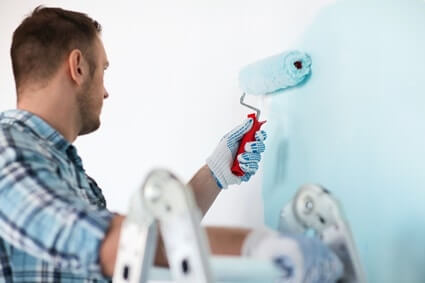
We all like to refresh our living space occasionally, which involves repainting the walls, ceilings, and skirting boards. If you intend to paint a parrot’s room, move it to a safe location.
Exposure to fresh paint can be life-threatening to birds because the fumes are toxic if inhaled.

Toxicity of Paint When Swallowed
Parrots are drawn to bright colors. So, they may investigate a newly painted surface, licking wet paint or ingesting flakes they break off a wall with their beaks.
Lead is a deadly toxin, but lead-based paint has been banned for home use since the 1970s. According to the Journal of Avian Medicine and Surgery, some paints are zinc-based.
Keep a parrot away from a room that’s been painted. Also, keep the door closed so toxins can’t escape, and paint cans, trays, and brushes are inaccessible to curious birds.
Dangers of Paint Fumes
Breathing in paint fumes harms the respiratory system of parrots.
Volatile Organic Compounds (VOCs)
Paints, notably oil-based paints, contain volatile organic compounds:
- Formaldehyde.
- Toluene.
- Ethylene Glycol.
- Xylene.
- Acetone.
- Methyl Ethyl Ketone.
- Naphthalene.
VOCs are chemicals used to make paints and primers, often as solvents or thickening agents. They’re also found in wallpaper, which is slightly safer than painting.
Veterinary Clinics of North America: Exotic Animal Practice stated that parrots frequently breathe in toxic fumes from their surroundings, which has life-threatening consequences.
As awareness of the risk of VOCs has grown more pronounced, most paint manufacturers offer low-emission paints. While they’re safer for humans, they aren’t bird-safe.
VOCs are released until the paint has cured. The more time that elapses, the fewer VOCs will be released.
Antimicrobial Paints
Anti-microbial paints are marketed as controlling the growth of fungus and mildew. This appears positive because parrots are vulnerable to airborne mold spores (Aspergillosis).
Unfortunately, antimicrobial paints release subtoxic substances that result in antimicrobial resistance. These substances reduce growth, making the surviving microbes more resilient.
Protection from Paint Fumes
The only way to protect parrots from paint fumes is to keep them 2-3 rooms away behind closed doors. Alternatively, ask a friend or relative (who the bird knows well) to house the parrot for a week.
Low VOC paints will be safer sooner, but a parrot must remain in a VOC-free room.
Follow these steps to expedite the paint-drying process:
- Open windows to let VOCs out.
- Use a fan to distribute air around the room.
- Apply a heat source, like a central radiator. Avoid small, direct heaters due to streaky drying.
- Get an air purifier or put plants in the room to remove airborne impurities.
When opening windows or using fans, ensure the parrot is caged (and the door is closed) several rooms away. The last thing you want is for the bird to escape or to blow VOCs into its living space.
Parrot-Safe Paint
While no paint is entirely parrot-safe, some types are less hazardous than others.
This table outlines the different paints and their suitability:
| Acrylic or Ceramic Paint | Acrylic and ceramic paints are often used by pet owners, people with children, and the immunocompromised. |
| Emulsion Paint | Most emulsion paints are water-based and have lower VOC levels. |
| Enamel Paint | Oil-based enamel paints have one of the highest levels of VOC release. Water-based enamel paint is better but should be approached with caution. |
| Latex Paint | Latex paint must be avoided. This paint emits the most dangerous fumes, even if the label states the paint is water-based. |
| Milk Paint | Milk paint is made from casein, a protein in cow’s milk, alongside calcium carbonate and sodium borate. It doesn’t emit fumes and dries in 30 minutes. |
| Spray Paint | Some use spray paint because it dries quickly, often in under an hour. If you let them dry, Krylon or Rust-Oleum are safe paints for bird cages. |
| Watercolor Paint | Watercolors are the safest paint because they don’t release fumes and dry quickly. They’re unsuitable for cage painting but are good for artwork. |
Water-based paints and basic primers are safe sooner than solvent and oil-based paints. Most paints, varnishes, glues, adhesives, and carpet cleaners give off VOCs.
Time Before Dried Paint is Bird-Safe
Don’t allow a parrot into or near a decorated room until the emulsion paint has been dry for 24+ hours. If an oil-based gloss has been used on a door or skirting board, it’ll be a week before the parrot can return.
Signs of Paint Toxicity
If a parrot has been exposed to paint, learn the warning signs:
- Lethargy and a generally dazed demeanor.
- Gasping for air.
- Gastric distress, like diarrhea or vomiting.
- Blood in the stool.
- Muscular tremors, potentially leading to convulsions and seizures.
If a parrot has paint toxicity, seek urgent veterinary attention. It has a very high mortality rate.