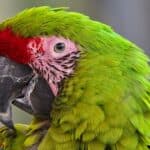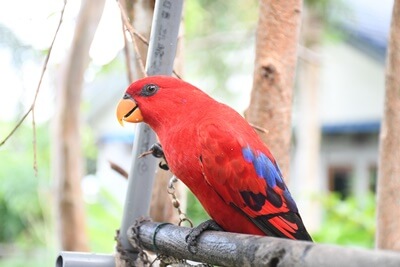
It’s against the law to capture and keep wild parrots as pets. They must be hatched and raised in captivity.
Capturing and removing parrots from the wild unbalances the ecosystem, which can have a severe environmental impact. Ornithologists and scientists closely monitor wild parrot populations.
Some avian diseases are zoonotic and can be passed on to humans.
Capturing and keeping a wild parrot in a cage is widely considered cruel. Wild birds are unaccustomed to confinement, becoming stressed, often developing stereotypies in captivity.
Instead, we should appreciate the beauty and vocalizations of wild parrots in the yard.
Wild Parrots Living in Urban Areas
Most people associate wild parrots with tropical conditions, expecting them to live exclusively in rainforests and jungles. Some species reside within significant metropolitan areas worldwide.
Wild parrots are sometimes introduced to urban areas to conserve the species. Unfortunately, deforestation and poaching have drastically reduced available terrain.
Former pets are also released into the wild and mate, forming a feral population.
The sulfur-crested cockatoo, long-billed corella, and rainbow lorikeet have a sizable population in Australian cities, while the Alexandrine parakeet is an invasive species in Tokyo.
The UK is home to rose-ringed parakeets, especially in and around London. Many American cities and states also have sizeable wild parrot populations.
The most commonly sighted parrots in urban parts of the U.S. include:
- Budgerigars.
- Peach-faced lovebirds.
- Blue-and-yellow macaws.
- Chestnut-fronted macaws.
- Mitered conures.
- Nanday conures.
- Blue-crowned parakeets.
- Canary-winged parakeets.
- Orange-chinned parakeets.
- Orange-fronted parakeets.
- Red-masked parakeets.
- Yellow-chevroned parakeets.
- Lilac-crowned Amazons.
- Red-crowned Amazons.
- Red-lored Amazons.
- Turquoise-fronted Amazons.
- Yellow-crowned Amazons.
- Yellow-headed Amazons.
These parrots have adapted to their new surroundings, forming colonies and attracting tourists. Unfortunately, wild and feral parrots are sometimes considered an agricultural nuisance.
Although parrots are gentle-natured birds, they may compete with native bird populations for food and resources, potentially reducing or eradicating local wildlife populations.
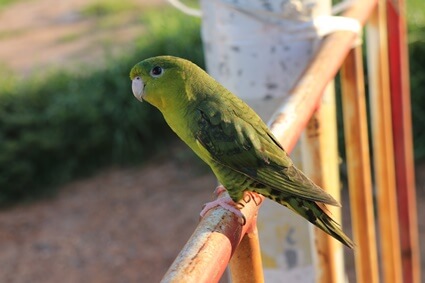
Friendliness of Wild Parrots
Wild parrots are curious and social, but calling them friendly is inaccurate.
Wild and feral parrots have no reason to trust humans. If you approach them, they’re likely to react defensively out of fear, which could include defensive biting.
Parrots that forage for food and share space with other birds, especially pigeons, can carry disease. The most common concern is psittacosis (parrot fever), a zoonotic disease of the lungs.
Seminars in Respiratory Infections stated that up to 200 cases of psittacosis in humans are reported annually. However, more people are likely to carry the disease asymptomatically.
Taming Wild Birds
Even with the best intentions, wild parrots will never respond positively to being restrained. Follow these guidelines to interact with wild parrots and tame them to avoid injury:
- Don’t follow the parrot or approach because it’ll be perceived as predatory behavior.
- Keep your distance and talk to the parrot calmly in an even tone.
- Avoid making sudden movements or gestures that will startle the parrot.
- Don’t tease the parrot. If you hold a hand out, the parrot will expect food.
- If it approaches and perches on your hand or shoulder, remain motionless and silent.
- If the parrot wants to escape, allow it to do so. Never restrain a wild bird.
Treat the bird respectfully, not as a feral animal.
Legality of Keeping A Wild Bird As A Pet
Wild parrots aren’t accustomed to living in cages. Birds kept in captivity from when they hatch often share this space with their mothers, so they feel comfortable with this arrangement.
Keeping a wild parrot as a pet is illegal in almost all countries and territories:
- America: Parrots are protected by the Migratory Bird Treaty Act 1918.
- Canada: Birds are safeguarded by the Canada Wildlife Act of 1985.
- Australia: Keeping a wild parrot is illegal under the Biodiversity Conservation Act 2016 and the Biodiversity Conservation Regulations 2018.
- UK: The Wildlife and Countryside Act 1981 protects the rights of wild birds.
These are federal laws, but local states, provinces, and cities may have further rules and regulations.
You’re unlikely to be imprisoned for capturing and keeping a wild parrot as a pet, but this changes if your decision significantly damages or harms other people or the environment.
The parrot will be confiscated upon discovery, and you risk severe financial penalties.
Rescuing A Sick or Injured Parrot
If you find a wounded parrot in the wild, you may consider it a moral obligation to rescue it and nurse it back to health. This remains a questionable decision.
There will likely be some leeway if you take the parrot home in these unfortunate instances.
However, you could still face prosecution unless you prove you’re qualified and have the skills and experience to rehabilitate the bird before releasing it.
Taking a wounded parrot directly to a veterinarian is usually permitted by law. Call ahead and confirm that the vet cares for wild birds. A vet will also check for a microchip to see if it’s an escaped pet.
If you don’t wish to handle the bird, call animal control, an avian wildlife sanctuary, or a registered charity like the ASPCA. They’ll send somebody over to assist (if they can) or offer over-the-phone advice.
Why It’s Illegal To Keep a Wild Parrot As A Pet
Here’s why keeping a wild parrot as a pet is unlawful:
Ethical Concerns
Many rehome captive parrots because they can’t cope with unwanted behaviors or provide the lifestyle the bird needs. A restrained wild parrot will become stressed and act out.
Taking a parrot home may deprive it of the essential skills to thrive in the wild. Parrots are prey animals and rely on finely honed instincts to remain alive.
Most parrots are socially monogamous, mating for life. If the parrot doesn’t return, its mate will mourn its loss. Its absence may also put its eggs or chicks in peril.
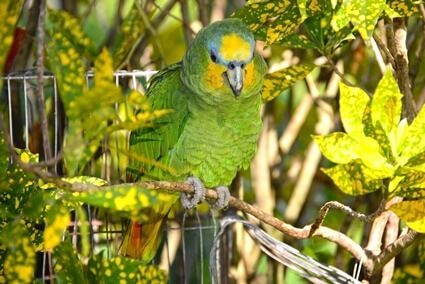
Safety
Wild parrots react adversely to being restrained. If the parrot is large, it may exert significant bite force. Bites are painful and break the skin, leading to bleeding and infection.
In addition to psittacosis, wild parrots can spread:
- Avian influenza (H5N1 strain.)
- Avian tuberculosis.
- Campylobacteriosis.
- Colibacillosis.
- Newcastle disease.
- Salmonellosis.
Avian flu can spread to epidemic levels, endangering the health of immunocompromised people.
When parrots are imported, strict quarantine protocols must be observed to minimize the risk of life-threatening diseases. These restrictions are hard to achieve in a family home.
Ecological Impact
The natural world has a balanced ecosystem, especially when non-native wild parrots have been introduced to a new territory.
Diversity explains how 166 different Psittaciformes have been introduced to over 120 countries worldwide. Changes can destabilize the bionetwork.
In addition, the WWF considers at least 18 species of parrots to be endangered or critically endangered, with another 40 classed as vulnerable.
Capturing and trading parrots for the pet trade is one of the reasons for these dwindling numbers.
Wild parrots are a gift to the natural world. Respect the right of wild and feral parrots to fly free, interact with them safely, and abide by national laws.