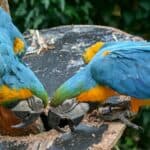
Parrots have holes in their beaks underneath the lower jaw or mandible. At first glance, it’s just a fleshy gap that looks like a piece of the beak is missing.
Parrots have an interramal space in their beaks that allows them to open and close their mouths, bite, and swallow food. It’s created by the U or V shape of the lower mandible.
This hole allows the parrot to use its mouth without jamming the rigid part of its beak against its throat.
This gap in the beak makes room for the tongue bone. Since parrots have a unique mouth and throat anatomy, they must accommodate multiple parts.
The glottis, choana, palate, salivary glands, esophagus, and laryngeal mound rely on this space.
Why Parrots Have A Gap Under Their Beak
There are benefits to the interramal space, including:
Opening And Closing The Mouth
Without the interramal space, the hard piece of keratin and bone would press down into the skin. To make room, this movement has been accommodated to keep the beak’s motion smooth.
Eating
A parrot’s tongue is nestled into the interramal space, providing access to the rest of the beak. It’s a secure area that protects the tongue while allowing it to move around.
Parrots rely on their tongues to eat and climb. Without this space, a parrot couldn’t survive.
Swallowing
The laryngeal mound and the tongue sit within this area of the mouth. They move and manipulate food, coaxing it down the esophagus as the parrot swallows.
Breathing
The interramal space holds the glottis, enabling the parrot to breathe when it closes its beak.
For this reason, the gap underneath a parrot’s beak enables it to inhale and exhale safely. The glottis connects to the choana on the roof of the mouth, connecting the nostrils and trachea.
Climbing And Playing
A parrot’s ability to climb is based on its unique tongue. More importantly, the tongue contains a bone.
Its unusual structure requires a hole like the interramal space to hold it firmly, allowing the parrot to close its beak and grab onto things more easily.
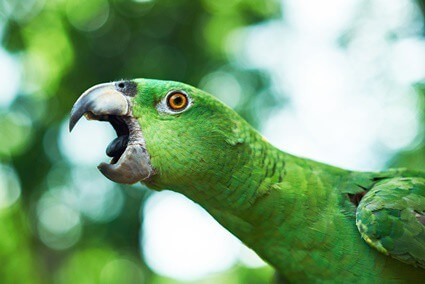
Why Parrots Have A Hole Under The Beak
The interramal space is a hub for several of a parrot’s most important beak and throat structures.
In particular, the oropharynx nestles into this lower beak hole. The oropharynx is a term that refers to a collection of parts of the anatomy, including the following:
- Tongue.
- Glottis.
- Choana.
- Palate.
- Salivary glands.
- Esophagus.
- Laryngeal mound.
- Opening of the Eustachian tubes.
So, the hole in a parrot’s beak isn’t just a gap that allows it to move its mouth effectively. The interramal space is central to a parrot’s ability to taste, swallow, digest, and live.
Parrot Beak Anatomy
Not every parrot will have the same beak color, shape, or size. However, they have the same structure:
Upper Mandible
The upper mandible is part of the beak that moves up and down.
A three-pronged bone called the intermaxillary supports it, which is embedded into the forehead. Simultaneously, two prongs on the lower part of the upper mandible attach to the sides of the skull.
The nasofrontal hinge facilitates the upward and downward motion. This is at the base of the upper mandible, where a sheet of nasal bones is found. The upper mandible also has a palate.
Lower Mandible
A compound bone supports the lower mandible, called the maxillary bone.
When combined, 2 ossified pieces of bone make a U or V shape. This is the basis for the maxillary bone. These pieces are joined in the front of the bone and left separated at the back of the bone.
An interramal space is formed because the bones are connected at the front.
This space holds the tongue and its supporting structures. Although the lower mandible and the muscles holding it together are weaker than those in the upper mandible, it remains a vital beak function.
The lower mandible’s V or U structure forms the iconic hole. If the beak were solid without the V or U shape, it would cut into the parrot’s throat whenever it closed its mouth.
This separation of the bones gives food enough room to pass as the bones move past the head.
Oropharynx
The outer surface of the beak is called the rhamphotheca, a thin sheath made of keratin. The tomia are the cutting edges present on the mandibles. Their size and shape vary for each parrot.
However, the most crucial part is the oropharynx. This contains many structures, each with a specific function, none working without the beak hole.
Tongue
Parrots’ tongues are unique as they contain a bone, so they can use their tongues to collect food.
Once inside the beak, the tongue can manipulate food around the mouth and swallow. Since this body part requires space to accommodate the bone, the interramal space makes this possible.
Glottis and Choana
The glottis is the opening of the windpipe (trachea). It’s paired with the choana, which is located on the mouth’s roof.
When the parrot can close its beak, the 2 structures join together, connecting the nostrils and windpipe.
Laryngeal Mound and Esophagus
Parrots have a small mound at the base of the tongue called the papillae or laryngeal mound. This also enables the parrot to guide its food toward the esophagus.
Without the benefit of the interramal space, a parrot wouldn’t be able to swallow its food correctly. The laryngeal mound wouldn’t fit, and food would be blocked from the throat.
Palate and Salivary Glands
The palate and salivary glands enable parrots to eat and digest their food. The laryngeal mound holds the food before being pushed toward the esophagus.
Salivary glands produce saliva, which helps food break down and travel through the esophagus. The pieces sit in the mouth of the parrot with the assistance of the interramal space.

Interramal Space Problems
It’s rare for issues to develop with the interramal space, but it happens. Check for these issues:
Development Problems and Malnutrition
A parrot may hatch with a genetic abnormality, causing a deformed or too-small interramal space.
Corrective surgery may be needed, but most parrots don’t survive for long with this defect. Should the parrot grow up despite this defect, it may need assistance eating or picking up food.
According to Exotic Animals Practice, malnutrition can cause these problems.
Malnourished chicks may develop a weak and brittle beak. The hole may chip, tear, or fail to grow like the rest of the beak.
Disease and Infection
The hole in a parrot’s beak is indirectly connected to the ear canals, where infections may develop.
This is usually caused by bacteria or viruses, leading to ear infections. Symptoms include swelling and redness that may enter the interramal space.
According to the New Zealand Veterinary Journal, bacterial sinusitis can cause severe beak deformities. Check for swelling, redness, or feather loss in the interramal space.
Trauma
If parrots crack their beaks against a hard object, their interramal space and the rest of their beak may get damaged. This is an unlikely area to be torn or ripped since it’s nestled under the beak.
This is more common with young or unsocialized parrots still learning their capabilities. According to the Journal of Exotic Pet Medicine, a dental composite can fix a damaged beak.
Signs of A Healthy Gap Under Parrot’s Beak
The hole underneath a parrot’s beak may look different from another’s. A healthy gap under the beak has all of the same structures.
These will be visible when the parrot opens its mouth. A parrot is healthy if none of these areas are inflamed, torn, or discolored.
Check that a parrot can open and close its mouth. If it refuses to open or shut its mouth the entire way, it may have an abnormal interramal space, but this is rare.