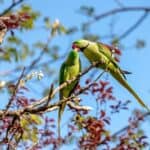
Parakeets are Psittaciformes, with almost 400 species across over 90 genera. Parrots in the superfamily Psittacoidea are called true parrots, and parakeets fall into this category.
Parakeets are part of the parrot family because they share these attributes:
- A hooked beak.
- Reproduce by laying eggs (oviparous).
- Brightly colored feathers.
- Zygodactyl feet (2 pairs of toes with 2 facing forward and 2 facing backward).
- Omnivorous diet.
Parakeet isn’t a term used to describe a junior parrot. Parakeets are smaller parrots defined by their long, thin tails. Some parakeets become slightly bigger, but most remain relatively small.
Parrot and Parakeet Differences
Parakeets are part of the parrot family, sharing similarities. Here are the differences:
Wild Origin
Most parakeets are native to Australia, which remains the country that hosts their largest population.
Small pockets of the U.S., most notably Florida, also host wild parakeets, but this is a consequence of household pets escaping and reproducing.
The U.S. was once host to a native parakeet called the Carolina parakeet (Conuropsis carolinensis,) but this species became extinct in 1939.
While the Green parakeet (Psittacara holochlorus) is occasionally spotted in Texas, it’s endemic to Mexico.
Parrots are found worldwide in tropical and subtropical climates, most notably in Latin and Central America, the Caribbean, Asia, and Africa.
While parrots are bred in captivity in the U.S., a formerly wild parrot will have been imported from one of these territories.

Appearance
Perhaps the most striking visual difference between parakeets and parrots is their size.
Parakeets are usually much smaller than parrots, as the average bird measures around 7-9 inches, while some parrots can be up to twice this size.
The tail of parakeets differs from parrots. Parakeets have long, pointed tail feathers, while the tail feathers of a parrot are usually shorter, blunter, and stubbier.
The feather color of parrots and parakeets can also indicate what bird you’re looking at. Most parakeets have green bodies and yellow heads, although color mutations, like blue, are also common.
Due to Psittacofulvins, parrots have a wider range of colors. Many species, like the scarlet macaw, African gray, and rose-breasted cockatoo, derive their names from the hue of their feathers.
Behavior
While both parakeets and parrots vocalize and chatter all day, parakeets are usually less noisy than large parrots because they’re smaller birds. The larger the parrot, the more noise it can produce.
Lifespan
Most parrots live longer than parakeets. For example, budgies (parakeets) live for 8-15 years, while African grays and cockatoos live for 40-70 years.
Parrot vs. Parakeet Intelligence
You may assume that a larger parrot has a bigger brain than a parakeet and is more intelligent, but this isn’t always accurate.
The African gray parrot is widely considered the smartest avian species, but Animal Learning and Behavior confirms that some parakeets can match them in understanding object permanence.
All psittacines can undertake training and learn tricks, tasks, and actions from their owners.
Parakeets Can Talk Like Parrots
The ability to mimic human speech and hold a conversation is among parrots’ most attractive features. While speech is linked to larger parrots, parakeets hold Guinness World Records for avian speech.
- An American budgie named Puck, who lived as a family pet in California before dying in 1994, had the largest-ever vocabulary, with 1,728 words.
- At the time of writing, a budgie in Germany called Oskar holds the record for the largest vocabulary of a living bird, with 148 unique words in his repertoire.
You must train a parakeet to communicate in human words over whistles and chirps.
Parrot vs. Parakeet
Some of the world’s most popular parrots and parakeets are classified as follows:
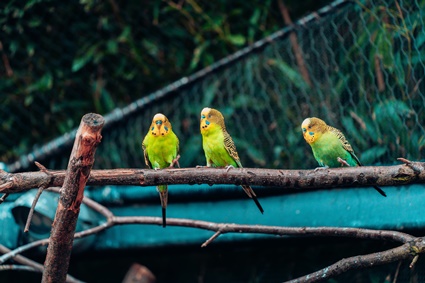
Budgies Are Parakeets
The terms “budgie” and “parakeet” are frequently used interchangeably, but this is inaccurate. All budgerigars are parakeets, but not all parakeets are budgies.
Budgies are the only member of the parrot family to belong to the Melopsittacus genus.
A traditional budgerigar (American budgie) is the third-most popular pet in the world after the cat and dog. The majority of parakeets sold in pet stores are American parakeets.
You may encounter a variation known as the English budgie. These are bigger than American budgies and defined by a squat, muscular body, large head, and fluffier feathers.
Most English budgies are used for presentation in bird shows rather than kept as pets.
Cockatiels Are Parrots
Despite their diminutive size, cockatiels are parrots, not parakeets.
A cockatiel is a smaller variation of the cockatoo, which isn’t a true parrot but is part of the parrot family. Cockatoos and their various subspecies, including the cockatiel, are part of the Cacatuoidea superfamily.
Conures Can Be Parrots or Parakeets
Conures are among the most varied groups of psittacines, meaning some subspecies are large parakeets while others are small parrots. The Carolina parakeet was once considered a conure.
Conures are usually classed as parrots rather than parakeets, primarily due to their noise. The sun conure can scream at 120 decibels, and conures grow to around 14 inches.
Indian Ringnecks Are Parakeets
The Indian ringneck (rose-ringed parakeet) is a parakeet, but it has more in common with parrots because it can grow up to 16 inches and live for 30+ years.
Parrotlets Are Parrots
Parrotlets are the smallest parrots kept as pets, usually smaller than parakeets. Despite this, they have a personality comparable to a full-sized Amazon parrot and can be feisty, fearless, and aloof.
Compatibility of Parrots and Parakeets
Parrots and parakeets should never be kept in the same cage. There’s often a considerable size difference, and not all species of parrots get along well together.
Even if the cage is large enough to accommodate both birds, a larger parrot will dominate or bully the smaller parakeet when competing for resources like food, water, and toys.
You can keep parrots and parakeets in the same room, but they must be housed in separate cages and only interact during supervised exercise and play sessions.
Allow the parrot and parakeet to grow used to each other’s presence from afar and create positive associations, like feeding both birds at the same time.
Avoid showing preferential treatment to 1 bird over another, as parrots can grow jealous.
When pet birds interact during free time, watch for signs of aggression, like screaming, fluffing the feathers, and pecking at the feet.
If the parrot and parakeet are coming into conflict, return both to their cage for a time out.