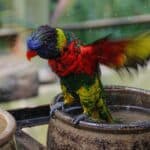
Most major airlines allow you to board planes with parrots on a first-come, first-served basis. However, restrictions are placed on how and when you can travel with pet birds.
Flying with a parrot in-cabin is preferable. Unfortunately, it isn’t always permitted. If a parrot needs to be stowed in the cargo hold, book a direct flight and label the cage as containing a “live animal.”
The parrot must be well-behaved. A loud, disruptive parrot must travel as cargo and not in-cabin.
There are also risks to flying with a pet parrot. Neighboring passengers may have unknown dander allergies, and the experience may be stressful for the parrot if the flight experiences turbulence.
Flying In-cabin vs. Cargo Hold with Parrots
Here are the airlines that allow pet birds to travel in in-cabin:
- Aeroflot Airline.
- Air Europa.
- Air India.
- Alaska Air.
- Alitalia.
- Delta.
- Frontier.
- Iberia.
- Vueling.
Here are the airlines that allow you to fly with a parrot in the cargo hold:
- Aegean Air.
- Aeroflot Airline.
- Air Canada.
- Air India.
- Alaska Air.
- Alitalia.
- British Airways.
- Finnair.
- Japan Airlines.
- Qantas.
- WestJet.
American Airlines and Virgin Atlantic don’t currently allow pet birds on flights.
Emotional Support Parrots
If you have registered a parrot as an emotional support animal (ESA), the same airline-specific rules apply to journeys with pet parrots.
ESAs aren’t offered legal protection during travel, so a no-birds-in-cabin policy still applies.
You may have heard stories of passengers taking ESAs onto airplanes, but the laws changed in 2020. Airlines traveling to and from the U.S. are no longer legally required to accept ESAs in-cabin.
Unfortunately, peacocks, miniature horses, marmosets, and pigs were all allowed into commercial flights as ESAs, leading to negative headlines and changes to the law.
The Lancet Respiratory Medicine explains how risks to other passengers due to allergies were also a concern. Parrot dust can cause respiratory distress for people with allergies and poor breathing.

Air Travel Safety for Parrots
While flying may be statistically the safest way to travel, there are undeniable health risks to taking a parrot on an airplane. Things to consider include:
- Bumpy, turbulent flights risk injury to parrots.
- The air may get thinner than usual, causing respiratory distress and panic.
- Parrots may grow stressed or overstimulated by the activity on a plane.
- If a parrot is stowed in the cargo hold, its cage may not be handled carefully.
- X-rays may be stressful for birds.
- The parrot will be confined to a cage for the duration of the trip to the airport, the check-in process, the flight, and the journey to your final destination.
Only take a parrot on a plane if you can mitigate these hazards.
Length of Flight
Some airlines limit the time a warm-blooded animal (endotherm) is allowed on a plane to 12 hours. Discuss this when booking a flight, knowing that shorter journeys are always preferable.
Passports for Travel
A parrot doesn’t need a passport to board an airplane. However, other documentation may be required.
Taking your parrot for a veterinary check-up before boarding a flight is recommended. This will verify that the bird is healthy and has a disposition strong enough to withstand the journey.
How To Travel With A Parrot by Air
If you want to fly with a parrot, here’s how to make the journey tolerable:
Direct Flight
Air travel is stressful for parrots, so avoid connecting flights. The parrot may grow distressed if you need to change planes, especially with long waiting times between flights.
Connecting flights carries risk when you aren’t traveling with a parrot in-cabin. A parrot may be shipped to the wrong destination or left alone in an unsuitable storage facility for hours.
Quieter Times
Avoid flights during the peak season when traveling with a parrot. Airports will be much busier, meaning the bird may be overstimulated or grow fearful.
Flights are likelier to be fully booked during peak vacation travel times. Even the most accommodating airline will be strict about the conditions of traveling with live animals.
If you fly at a quieter time of year, airline crew members are likelier to be flexible with how the parrot is stored. If every seat on the flight is occupied, rules must be followed to the letter.
If a passenger has a bird allergy and the flight is fully booked, you must stow it and be separated for the entire journey. On a half-empty flight, you can be easily relocated.
Avoid seasons where temperatures will be extremely high or low. If the temperature is above 85°F or below 45°F, airlines may refuse to allow the parrot onboard.
Check The Rules
Before booking flight tickets, check the parrot is entitled to travel. Don’t leave anything to chance, finding that you didn’t read the small print when you arrived at the airport.
Things to check and confirm before finalizing a booking include:
- Does the airline reserve the right to change its policy on animal passengers at short notice?
- Are a limited number of pets allowed on a flight, issued on a first-come, first-served basis?
- Do different rules apply for long-haul flights or international travel with parrots?
Speak to the airline over the phone to get the answers to these questions.
Travel Cage
A regular cage will be too large to take on a plane, especially if you intend to keep a bird in-cabin.
The cage must allow enough space for the parrot to stand upright and stretch its wings. However, it can’t be so big that the parrot risks being tossed around during air turbulence.
Once you have a travel cage, encourage the parrot to spend time in it before the journey.
Secure The Parrot
A travel cage will be the parrot’s home for several hours. Consider the following factors:
- Security. Ensure the parrot can’t escape. Tie wraps around doors and hatches.
- Perches. Remove perches from the cage bar one and put this no higher than an inch from the cage floor. Air travel can be bumpy and turbulent, so falls must be avoided.
- Cover the cage. If a parrot can’t see the activity at an airport, it’s less likely to grow overstimulated.
- Provide food and water. You may be unable to replenish food or water during the flight.
Air travel will be a frightening experience for a parrot, but these measures will ease the stress.
Quarantine
If you’re flying overseas, check quarantine rules that affect parrots upon arrival. Some countries insist that birds are isolated upon landing, especially if you bring them home for the first time.
Check domestic regulations to ensure the species isn’t restricted. Some states won’t allow Quaker parrots because they’re invasive, while others want a license for specific bird species.
Many airlines accommodate requests to fly with a parrot, especially on short-haul flights at quieter travel times. However, there will always be risks in taking a pet bird on a plane.