Inbreeding involves mating two parrots directly related by their bloodline. Brothers and sisters are the most common example, but it could apply to breeding a father and daughter or a mother and son.
If you inbreed parrots, the offspring will share identical DNA. If both siblings inherited a defective gene from a parent, like a hereditary disease or deformity, they’re likelier to pass this on to their offspring.
Sibling parrots that breed with each other are likelier to produce infertile offspring, assuming the embryos survive. Many eggs from inbreeding are unviable and will never hatch.
Inbreeding in parrots is rare but can happen in captivity if a brother and sister form a pair bond. Parrots don’t recognize each other as siblings, meaning mating is possible.
Parrot Sibling Recognition
Parrot chicks are kept with their siblings so they mature and achieve fledgling status together. A parrot won’t be fully weaned for about 16 weeks, when it’s likely to be separated from its mother.
Wild parrots usually leave the nest and live independently in a same-species flock. This ingrained behavior is intended to reduce the risk of sibling inbreeding.
This ties in with the findings of Biological Reviews, which explains how wild birds recognize each other through behaviors like physical and verbal tics, flock-specific calls, and singing.
If parrots spend their formative days together, they’ll recognize each other as they sexually mature. What’s less clear is whether the parrots realize they’re related to each other.
Mating Between Parrot Siblings
Wild parrots instinctively seek a mate from a different flock to retain the purity in their bloodline, reducing the risks associated with inbreeding.
Captive parrots are likelier to breed with their siblings if they live together. When hormones are elevated during mating season, brother and sister parrots may choose to mate.
The parrots may not realize their siblings, so they see each other as bonded mates.

Breeding Parrot Siblings
Inbreeding can happen by accident or design, but is inbreeding parrots bad?
Most experts advise against it. Some believe that first or second-generation inbreeding may not lead to complications, but health issues arise in offspring from the third generation onward.
Unless you’ve been provided with a family tree from a parrot breeder, displaying conclusive evidence the parents were unrelated, you can’t be entirely sure what generation they fall under.
Inbreeding vs. Line Breeding
Line breeding involves breeding animals from a more distant relative than a direct sibling. An example of line breeding is keeping one male as a stud and mating him with many unrelated females.
If a single stud mates with 3 female parrots, all of whom lay a clutch of 3 eggs each, the chicks will be half-siblings. This offers sufficient genetic variance to minimize problems with the offspring.
If sibling parrots mate, the offspring will share identical DNA, similar to human twins or triplets. Complications can arise, which is why inbreeding with a direct blood relative is best avoided.
Effects of Inbreeding Parrots
Inbreeding isn’t entirely avoidable in the wild, as with the kākāpō (owl parrot.)
The kākāpō is listed as critically endangered by the International Union for Conservation of Nature because the population is limited to 2 islands in New Zealand.
As the population of kākāpō is so tiny, inbreeding is unavoidable if the species is to avoid extinction.
However, the journal G3: Genes, Genomes, Genetics has identified no direct correlation between reduced mortality and inbreeding in this fast-declining parrot species.
Chicks sired by parrot siblings are at risk of the following:
Infertility And Early Embryo Death
A risk of inbreeding parrots is the eggs will never hatch.
Biology Letters explains how inbreeding can lead to incompatible fertility and inbreeding depression. This means the embryos aren’t healthy enough to survive.
Inbred males are also likelier to be infertile than their line-bred counterparts. A female will still lay unfertilized eggs. Once this occurs, candle the eggs to see if they have embryos.
Hereditary Sickness
Breeding sibling parrots results in chicks with identical DNA. Alcohol Research and Health explains that their alleles are the same, meaning the offspring will have the same genes as the parents.
Let’s assume a parrot has problematic genes that could lead to hereditary sickness in its offspring.
If the parrot breeds with a non-family member who doesn’t carry these genes, the likelihood of baby parrots having the same condition upon hatching is halved.
If this parrot breeds with a non-family member that doesn’t share these genes, the risks are halved again. The issue can be erased from the bloodline, hence why line breeding is safer.
Physical Deformation
Physical deformities are frequently cited as a hazard of inbreeding mammals. Zoo Biology states that inbreeding two sibling budgies is inadvisable, and the same applies to all parrot species.
Parrots that hatch following inbreeding between sibling parents have a higher risk of blindness or missing eyes. Malformation of the wings or limbs is also possible.
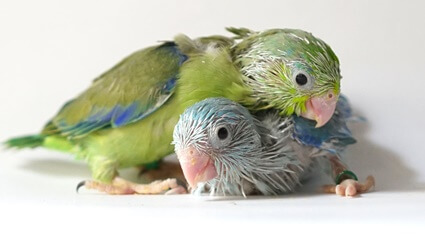
Preventing Sibling Inbreeding in Parrots
You can keep sibling parrots if you prevent them from mating. Here’s how:
Separate Siblings
Parrots are social animals. However, they don’t need to be in the same cage to benefit from each other’s company. If you have opposite-sex siblings, house them in separate cages in the same room.
While the parrots are very young, they may draw comfort from proximity and living together.
You must understand when to separate baby parrots to prevent inbreeding, which involves learning when they reach sexual maturity. Here’s when parrots sexually mature:
- Small parrots, like budgies, lovebirds, and cockatiels, mature within 6-12 months.
- Medium parrots, like conures and lorikeets, achieve sexual maturity between 12 and 36 months.
- Large parrots take several years to mature, becoming sexually active between 4 and 7 years old.
Help the parrots adjust to independent living early on. Don’t wait for the parrots to display hormonal behaviors before moving them because this enforced separation will exacerbate sexual frustration.
Control Hormonal Activity
When parrots are sexually mature and enter the breeding season, they’ll show interest in mating. This will arise at the onset of spring because the days get longer and the temperatures become warmer.
Signs that parrots are hormonal and want a sexual partner include:
- Increased hostility and aggression.
- Sharing regurgitated food.
- Replicating wild nesting behaviors by removing feathers to insulate the nest.
- Growing territorial when you approach the cage.
Reduce a parrot’s frustrations by doing the following:
- Covering the cage earlier so the parrot doesn’t realize the days are getting longer.
- Avoid petting parrots on the wings, back, or tail.
- Remove anything in the cage that could be used as a nesting box.
- Avoid leaving dark and secluded places that could be used for nesting.
- Keep the temperature down, as warmth signifies the onset of spring.
Two male parrots can still grow sexually frustrated if denied the opportunity to mate. Also, two females may produce a clutch of unfertilized eggs if hormone levels become elevated.
Inbreeding results in unviable eggs and hatching mortality. The surviving chicks may be compromised by health problems and deformities (missing eyes and limbs) passed on through defective genes.