Psittacine birds start flying after fledging, usually once they reach 10-12 weeks old. A fledgling will have developed its first set of feathers and will move and fly freely.
Large parrot species (like macaws) may take 4-5 months to develop sufficiently to take to the air, while some small species (like budgerigars) may start flying after just 4-5 weeks.
Parrots learn flight techniques from their parents. Developing the skills to fly is gradual, so a parrot won’t immediately fulfill its potential. The first few flights will be relatively short and close to the ground.
How Parrots Fly
The science of parrots’ flight can be explained through Newtonian physics.
Flapping a parrot’s wings is called “acceleration” (a.) This creates “mass” in the air (m), which raises the parrot off the ground. This defiance of gravity generates “force” (ma).
An airborne parrot won’t continuously flap its wings to create force. Once it has achieved flight, The Royal Society explains how it can spread its wings and glide using wind or hovering.
The following parts of the avian anatomy are involved in taking to the sky and remaining airborne:
Wings
The wings are crucial to flight. The feathers on a parrot’s wings are called primary feathers, and these are complemented by secondary feathers, which are located on the inner wings.
The primary feathers, made of beta-keratin (β-keratins), allow a parrot to take to the air when force is generated. Feathers are closely connected, combining with the wind to keep the bird airborne.
These feathers molt and regrow to overcome wear and tear caused by regular flight.
The secondary feathers are also vital for flight because they help them maintain height by trapping air. A parrot can fly without secondary feathers but with less control and coordination.
Tail
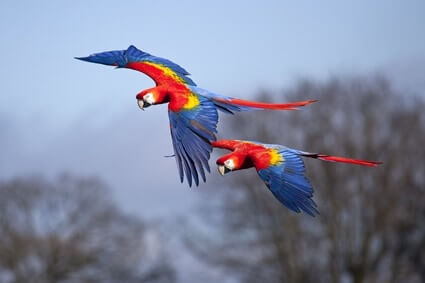
Parrots utilize their tail in flight to lift the body and retain balance.
This is essential because the wings are slightly ahead of the center of gravity. The tail enables the parrot to maintain direction, steer, and create wind resistance when it wants to land.
Skeleton
A parrot’s breastbone (called the keel or carina) is an anchor for the wing muscles, enabling take-off.
The lightweight skeleton assists with flight. Parrots have hollow bones that make it easier to remain airborne and glide when carried forward by the wind.
Legs
A parrot relies on its legs to initiate flight and take to the air.
Most parrots hop ahead before taking to the air, using their leg muscles to gain sufficient altitude to commence flight. The leg muscles can also withstand air pressure.
While a parrot is in the air, it doesn’t need to use its legs. This means the legs remain static throughout the flight and are only utilized when the parrot needs to land.
Heart
A parrot’s heart has 4 chambers, which can beat up to 800 times per minute while flying. This means parrots have a high metabolic rate, regenerating enough energy to sustain flight.
Lungs And Air Sacs
Parrots have a high metabolic rate to sustain flight, requiring constant oxygen. They have air sacs attached to their lungs to provide the body with enough oxygen.
While in the air, parrots take in air through their nares (nostrils).
The nasal cavities purify oxygen, filtering out impurities before moving to the trachea and syrinx. Then, oxygen is transported to the lungs and air sacs.
In one breath, the parrot exhales air from the lungs. While the body waits for a fresh supply of oxygen, air stored in the air sacs is used to breathe.
This is why parrots can constantly remain airborne without losing breath.
Why Parrots Fly
Wild parrots fly for various reasons, mostly related to survival. These include:
- Fleeing from a threat, like an adversary or bad weather.
- Foraging for food or responding to a flockmate’s call announcing its discovery.
- Looking for a new partner during the breeding season.
Parrots also fly for fun and exercise because it’s fundamental to their well-being.
Not All Parrots Can Fly
The only flightless parrot species is the kākāpō (Strigops habroptilus).
The Kākāpō (owl parrot) reaches 25 inches and weighs up to 9 pounds at maturity. This makes the kākāpō the heaviest parrot species. This weight and shorter wings mean the kākāpō remains on the ground.
The kākāpō is a critically endangered species, with New Zealand’s Department of Conservation claiming that less than 250 remain alive today. All kākāpō live on just 2 islands.
Time of Day Parrots Fly
Wild parrots only fly during daylight hours. They don’t fly at night because they have limited vision in darkness, which makes flying fraught with peril.
Except for the night parrot (Pezoporus occidentalis,) a critically endangered nocturnal species native to Australia, parrots are diurnal.
Parrots usually sleep through the night, waking at dawn, which is safer.
Parrots nest in tree cavities, so they’re safe from mammalian predators. Other birds, especially eagles, falcons, and hawks, are the main threat. A parrot will take to the air at night if its life is in danger.
How Parrots Change Direction When Flying
While a parrot is in the air, it uses its wings and tail to alter direction. While the wings and tail are outstretched and unmoving, the parrot will continue to glide forward in a straight line.
If the parrot needs to turn, it tilts its wings. For example, a flying parrot that needs to turn left will tilt its wings in that direction. The same applies if a parrot needs to steer to the right.
If the parrot wants to move closer to the ground, it’ll lift its tailbone to create more wind resistance. This will slow its path and lead to a steady descent. Then, it’ll glide and hover until it reaches a safe height.
How Long Parrots Can Fly For
If a parrot has a reliable source of food and water nearby, it’s unlikely to travel far. Large parrots may travel up to 10-30 miles to find food.
The longest journey is made by the orange-bellied parrot (Neophema chrysogaster), which migrates back and forth (187 miles) between Australia and Tasmania twice a year during migration.
How Parrots Stay Airborne for So Long
Aside from using their efficient respiratory system, parrots glide for as much of their journey as possible. The stronger the wind behind a parrot, the further it can travel without growing exhausted.
Parrots will stop and rest if they’re too tired to continue flying. A parrot fleeing a predator will put as much distance between itself and the threat as possible before catching its breath.
How High Parrots Fly
Parrots usually fly about 500 feet above the ground. This keeps them safe from land-dwelling threats, provides access to trees, and avoids airspace populated by birds of prey.
Raptors are often found 10,000 to 15,000 feet above the ground.
During migration, parrots will fly higher. They can fly up to 5,000 feet from the ground during these seasons because they’re keen to cover more ground faster to reach their destination.
According to the Journal of Ornithology, parrots move faster with a strong wind behind them. The parrot will encounter less wind resistance by soaring above trees and tall buildings.
How Fast Parrots Fly
Parrots, like cockatoos, have an average cruising speed of 20-30 mph. Parrots, like macaws and African grays, can reach a top speed of up to 50 mph.
The Public Library of Science explains that a parrot’s size and body mass won’t directly influence travel velocity. A parrot’s speed depends on the species, wind velocity, and reason for flight.
Parrots escaping predators will move faster than those exercising and looking for something to do. Migrating parrots will move steadily to conserve energy and reach their eventual destination.
Parrots Flying Alone vs. Flocks
Wild parrots are rarely found alone, whether perching, roosting, or flying. It’s common to see a flock of parrots take to the air and fly together.
This behavior is driven by there being safety in numbers. An airborne predator can easily pick off a single parrot, while a flock of parrots is likelier to be avoided.
Traveling together means parrots can identify threats and warn each other through loud contact calls. Then, the flock can unite to defend each other if necessary.
Parrots also travel in groups because they have a shared common goal.
The flock will migrate to warmer terrain or heed a call that a source of food and water has been found. Animal Cognition said that parrots share resources with other flock members.