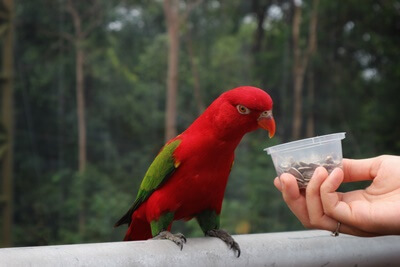
Food guarding involves a parrot jealously defending its food bowls, refusing to allow you to remove them from the cage, or preventing other birds from accessing its contents.
The more generic term resource guarding applies when a parrot displays these behaviors toward other objects, such as a favored toy, swing, ladder, mirror, or perch.
According to the Journal of Field Ornithology, resource guarding is common in wild parrots. They’ll protect preferred nesting spots and food supplies, an instinct that hasn’t gone away.
Signs of Resource Guarding in Parrots
If you’re unsure if a parrot is guarding resources, check for these signs:
- A parrot refuses to leave a food dish unprotected, possibly extending to sitting in the bowl when resting or rushing to the vicinity whenever you or another bird approaches.
- When you provide treats, one bird attempts to force the other out of the way.
- A parrot intentionally blocks access to a food bowl or water bottle.
- A parrot raises its wings to show hostility when another bird attempts to eat or drink.
- Signs of injury on one parrot, like missing feathers and bleeding.
If these actions become persistent, guarding behavior is an ingrained problem.
How Resource Guarding Starts
Resource guarding has the following causes:
- Past trauma, such as extended periods spent without food or water.
- 2+ birds are forced to share a small space, leading to competition over space, food, and resources.
- Unreliable, erratic scheduling surrounding mealtimes, leaving the parrot concerned it won’t get fed.
- Previously removing a food bowl or other valued resource as a punishment.
- Removing objects from the cage when wearing brightly-colored clothing, like red, orange, or yellow.
- Insufficient free roaming makes the cage seem like it’s the only safe place.
Dangers of Resource Guarding
If one parrot can’t eat or drink, it’s unlikely to survive for more than 24-72 hours.
If a parrot grows distressed and aggressive each time you approach its cage, consistent exposure to stress can have health implications, resulting in a reduced lifespan.
If a parrot becomes defensive of its resources, it’s likely to bite to safeguard them. The journal Hand warns that parrot attacks can lead to infection as the parrot’s mouth hosts bacterial microbes.
Resource Guarding Won’t Go Away
Once a parrot starts resource-guarding, the behavior won’t stop without intervention. It will become increasingly aggressive and possessive over its possessions.
We must teach the parrot that a food dish or other resource isn’t life-critical or irreplaceable.
How To Get Parrots To Stop Food Guarding
Try offering two food bowls at mealtimes, with a serving for a pair of birds divided in half. Each bird may gravitate toward a separate dish if the bowls are different colors.
If you have two cages, consider temporarily rehoming one parrot during mealtimes. This will help each parrot understand which food bowl it has been assigned.
We advise alternating which parrot is moved so neither feels it’s being punished for instinctual behavior.
Before reintegrating the parrots, check how they interact when no resources are disputed. If they avoid contact, they haven’t bonded and may benefit from living apart permanently.
Consider if you’re inadvertently contributing to resource guarding. Avoid wearing bright colors associated with danger, approach slowly, smile, and speak to the parrot reassuringly.
Do the following when ready to train a parrot to stop resource guarding:
Change The Food Bowl
If the parrot always eats from the same bowl, it’s likelier to continue to do so.
Parrots are neophobic (fearful of the unfamiliar), so don’t just change a food bowl and leave them to eat. The parrot may refuse to approach the dish, especially if it’s brightly colored (red, orange, etc.)
While a parrot is outside the cage, leave some empty food bowls in a location it can access. Encourage it to interact with them so it realizes they aren’t toxic or dangerous.
Remove The Parrot from Its Cage
Food guarding is associated with a dish within the parrot’s cage or the immediate vicinity. By removing this object, it sees you as invading its territory. You must break this association to prevent food guarding.
Release the parrot from its cage in a safe room, and encourage it to perch elsewhere in your eye line. Ideally, this won’t be another cage but a freestanding perch or hammock.
Use clicker training and basic commands to encourage it to remain on its external perch.

Touch the Food Bowl
While the parrot is perched, approach its empty food dish. Then, touch the dish without removing it. When the parrot sees you interact with the dish without reacting, reward it with a treat.
Repeat this step several times, regularly approaching the bowl without attempting to remove it, praising the parrot each time it remains in position.
Remove the bowl from the cage and place it close to the parrot. It’ll likely investigate, hoping to find food in the dish. Let the parrot see that the bowl is empty and put it where it can be seen.
Feed The Parrot
While the parrot watches, fill the bowl with food.
Continue to clicker-train the parrot to remain in place, offering rewards. If the parrot loses composure and lunges for the food, empty the bowl and repeat the previous step.
Once the bowl is full, return it to its usual position in the cage. Let the parrot know it is free to eat. Let it fly to its cage to eat, praising it throughout.
The parrot will now understand that removing a dish from a cage means receiving more food, not less.
Consequently, it’ll consider your interaction with its possessions a positive experience and won’t react adversely when you next attempt to remove the food dish.
If you struggle to convince the parrot to accept this arrangement, leave the food dish in a neutral location outside the cage and allow it to eat there. You can return to the training later.
While parrots are clever animals, resource guarding is a primal instinct that some birds struggle to shake off. You can help a parrot overcome the desire to hoard and protect its treasured possessions.