Hahn’s macaws (Diopsittaca nobilis nobilis,) also called red-shouldered macaws, are the smallest members of the macaw family. Hahn’s reach a maximum of 12 inches long.
While Hahn’s are ‘mini macaws,’ they retain the larger-than-life persona of other macaws. Beginners can own a red-shouldered macaw but may initially find them challenging.
Hahn’s macaws are noisy birds, with squawks regularly exceeding 100 decibels. They’re clever parrots who can become accomplished talkers and develop an extensive vocabulary.
Hahn’s will bond with those who meet their care needs, making them good family pets.
Hahn’s Macaw Suitability As Pets
Their small size makes them appealing. Caring for a Hahn’s macaw isn’t as straightforward as looking after a budgie. Their temperament means they’re less demanding than a larger macaw species.
The pros and cons of a Hahn’s macaw must be considered before introducing them to your home. Sadly, macaws are often rehomed because people underestimate the time and financial commitment.
Physical Appearance
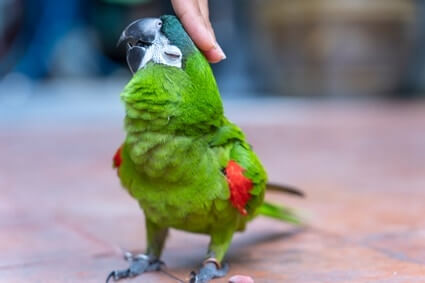
Hahn’s resemble the noble macaw (Diopsittaca nobilis cumanensis). The difference is that a noble macaw has a beige beak, while the beak of a Hahn’s macaw has black tips.
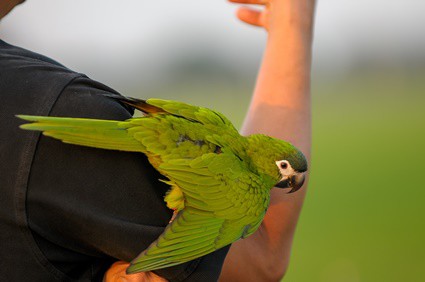
Once they reach maturity, their plumage will primarily be green, although the cap will be closer to blue. A flash of bright red under the wings earns them the nickname “red-shouldered macaws.”
The eyes are a deep shade of burnt orange, framed by white rings.
The feet are black and initially seem oversized compared to the rest of the body, but Hahn’s macaws are agile and nimble, comfortably negotiating their environment.
Size And Weight
At just 12 inches and 140 grams once fully grown, Hahn’s are the smallest member of the macaw family. A Hahn’s macaw is slightly bigger than a cockatiel, the smallest cockatoo species.
Male vs. Female
Sometimes, a male Hahn’s is slightly bigger than a female, but this isn’t guaranteed. Age and posture influence size and mass, so get a DNA test to determine the parrot’s gender.
Female Hahn’s may lay eggs, even without a mate. While producing unfertilized eggs rarely happens in the wild, it’s common in captivity due to artificial lighting, petting, and heating conditions.
They have challenging behaviors and undergo personality changes when hormonal. They reach sexual maturity at 2. Immediately preceding this, a parrot will experience the “bluffing stage.”
A Hahn’s macaw will become sullen and moody, experiencing significant mood swings and emotional volatility. This can lead to hissing, lunging, and biting.
The bluffing stage can last anywhere from 2 weeks to several months.
Hahn’s may also exhibit unpredictable behaviors during the mating season, which unfolds during the spring. Their hormones will be elevated, and they may become frustrated without a mate.
Aside from hormonal volatility, females are usually relaxed, while males are more excitable and playful. Consider these factors when deciding whether to get a male or female macaw.
Average Lifespan
Getting a parrot involves caring for a bird with a long lifespan, but how long do Hahn’s macaws live? The average life expectancy of a Hahn’s macaw is 20 to 30 years.
Personality Traits
The personality traits revolve around mischievousness and affection toward humans. Once you bond with a Hahn’s macaw, it’ll likely be a cuddly parrot, nuzzling its beak against you.
Juvenile Hahn’s macaws can be nippy, but consistent training can reduce this behavior. A tamed Hahn’s macaw is safe around children (with your supervision) when it isn’t mishandled.
Shower a Hahn’s with attention to maintain a harmonious bond. A parrot will develop separation anxiety if left alone for too long and won’t respond well to being ignored.
Once a Hahn’s feels comfortable, it’ll become increasingly fun-loving and playful. Expect to see the parrot dance to music and ask to play games.
A Hahn’s will be content to perch on your shoulder and watch TV.
Quiet vs. Noisy
Hahn’s can be loud, so they’re unsuitable for homes with close neighbors and thin walls. For example, Hahn’s macaws aren’t good apartment birds.
If you get a pet macaw, expect it to squawk when it wakes up, is startled or frightened, is excited, or wants attention. These vocalizations often exceed 100 decibels.
Talking Ability
Hahn’s are skilled at mimicking human language. If you bond with a Hahn’s macaw and engage in regular speech training, they can learn up to 50 words, sometimes forming sentences.
Like all parrots, Hahn’s learn to talk through repetition. Dedicate around 20 minutes daily to teaching your pet new words and reward it for its efforts.
Hahn’s macaws speak in a high-pitch once a word is mastered.
Hahn’s macaws prefer whistling to communicate. If you don’t regularly interact and perform speech training, they’ll likely revert to whistling over speaking.
Feather Molting
Hahn’s molt their feathers once or twice a year in the spring or fall. This involves old, damaged feathers organically falling out with new replacements growing.
A molt can take up to 2 months to conclude, during which Hahn’s will be uncomfortable and irritable. Spray them with water to ease the itchiness and discomfort.
Most parrots release dander, known as parrot dust, which can trigger allergies. No parrot is hypoallergenic, but macaws usually shed less dander than others.
Problem Behaviors
Once you establish a schedule and the parrot understands when to expect food and attention, it’ll expect its needs to be met at those times. It’ll let you know through its unhappy vocalizations if you’re late.
A parrot may become stressed if you fail to meet its care needs. This can lead to stereotypies – repetitive, potentially destructive actions that serve no purpose.
Common stereotypies in Hahn’s macaws include:
- Pacing back and forth in the cage.
- Chewing on cage bars incessantly.
- Feather-destructive behavior.
Parrots are prone to feather plucking when distressed, which can cause permanent damage to follicles.
Cage Size
A cage measuring 40″ x 30″ x 65″ and with bar spacing of 3/4″ to 1″ will be large enough to accommodate a Hahn’s. This will allow it to stretch its wings and move about freely.
Hahn’s are social birds, so put their cage where they can interact with the family without growing overstimulated. Avoid placing the cage too close to a window, especially in a noisy room.
The cage should contain at least 3 perches at different heights and angles to give them various vantage points. Offer a regularly rotated selection of toys and puzzles.
Consider getting a second cage for them to sleep in, placing this in a room with less footfall or noise overnight. A Hahn’s macaw’s cage can be covered to provide darkness.
Food
Hahn’s should be fed upon waking in the morning and again in the evening, around an hour before sleep. Feed the parrot after its time out of the cage has concluded.
A Hahn’s diet should comprise 50-70% quality pellets, fruits, veg, nuts, and seeds.
Never feed a Hahn’s chocolate, onions, or garlic because they’re toxic to birds. Here are some other human foods that are dangerous for pet birds.
Drinking water should always be available. This can be provided in a bottle attached to the side of a cage or a dish. Most birds won’t survive for more than 72 hours without water.
Cost
The cost of a Hahn’s macaw is $650 to $2,000. If you buy a Hahn’s from a breeder, it’ll be at the upper end of this price range. If you purchase one from a rescue center, it’ll be less expensive.
Baby and juvenile Hahn’s cost more because older parrots are harder to train and bond with than younger birds. Also, they may have health conditions and fewer years left to live.
Hahn’s macaws are charming birds celebrated for their intelligence, mimicry, and friendly disposition. Consequently, they make good beginner pets, especially if a larger macaw species isn’t an option.