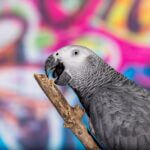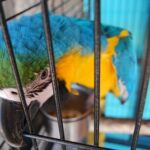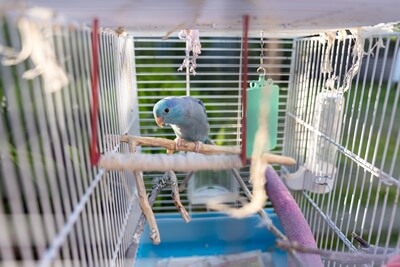
A pet parrot spends most of its time caged, so the environment must meet its everyday needs. All parrots eat and drink, perch, poop, bathe, and play to keep themselves busy and mentally engaged.
Think carefully about where you locate a parrot’s cage because some rooms are more suitable. The best place for the cage is near you, like the living room, so it has companionship.
The ideal cage position is in the corner of the room, where two walls provide coverage. Parrots can’t absorb vitamin D through glazed windows, so they’ll need at least 3 to 4 hours of UV lighting.
What To Put in A Parrot’s Cage
The better a parrot’s cage setup, the more time it’ll contentedly spend there. The following items should be added to the cage to keep it happy and contented:
Food And Water Bowls
Food dishes should be affixed to the side of a cage and never placed directly below a perch. If a parrot sits above its food, it’ll poop in the dish, tainting the contents.
Provide at least 2 water bowls. A small dish of drinking water on the floor and a bottle affixed to the side of the cage is a workable setup.
Keep food and water within easy reach of perches. Parrots are likelier to eat and drink if they can do so from a position of comfort. Of course, wash and change the contents of the dishes as required.
Perches
A cage should have perches positioned at different levels and angles.
| Wooden perch | This is the most common perch, imitating the tree branches a parrot would stand on. They help a parrot wear down its nails and can be a chew toy. |
| Calcium perch | It’s like a wooden perch but constructed from cuttlefish bone or another aragonite source. A parrot can eat its perch to glean extra calcium. |
| Flat perch | A flat perch will be more accessible if a parrot has debilitating foot issues, whether through injury or musculoskeletal deformity. |
| Swing perch | These perches provide fun and exercise, especially when equipped with toys like beads. |
| Ladder perch | Parrots find climbing ladders fun, but they can rest if they become tired. |
The number of perches a parrot needs depends on the cage size, but aim for at least 3.

Tub for Washing
Parrots grow uncomfortable if their skin and feathers become unclean and disorganized, so they need the opportunity to bathe. Birds enjoy splashing in the water, so they’re happy to wash.
A parrot may enter the water and splash around. Ensure the bird bath has a lid to contain the water, especially if positioned near electrical sockets. Parrots are messy birds.
Toys
All parrots need toys to keep themselves entertained. Parrots often fear unfamiliar objects (neophobia), so new toys may cause more apprehension than enjoyment.
Once a parrot has adapted to toys, ensure that all aspects of play are covered. Baby toys are often parrot-safe and appeal due to their bright colors. They’re also constructed from non-toxic materials.
Parrots love any toy that moves and welcomes interaction. Here are some suggestions:
| Climbing frames and swings: | If you’re not using a ladder or swing perches, provide other opportunities for a parrot to engage in these activities. |
| Foraging toys: | Hide rewards and treats in boxes or behind movable objects. The Journal of Comparative Psychology stated that parrots understand object displacement, which appeals to their foraging instincts. |
| Mirrors: | Parrots are fascinated by their reflections, so keep a mirror in the cage. Remove them if a parrot mistakes the mirror for a second bird and becomes aggressive. |
| Noisy toys: | Parrots like to make noise. Provide bells, musical instruments, rattles, etc. |
| Paper and card: | Parrots love to shred paper or cardboard to pieces. |
| Soft toys: | Chicks cuddle up to soft toys and play fight with them. Older parrots hold onto objects with their feet while they peck, bite, and chew. |
Applied Animal Behavior Science noted that rotating some toys, rather than keeping the same ones in place permanently, can assist with a parrot’s fear of new things.
Hiding Places
Even social parrots grow overwhelmed by constant stimulation or unending interaction. Consequently, they sometimes seek a private, secluded location to hide temporarily.
One way to give a parrot privacy is to cover its cage with a blanket when it sleeps. Another is to consider getting a hanging tent. These are solid constructs to which a parrot can retreat when overwhelmed.
Bedding
Wild birds sleep on tree branches, which means captive parrots are just as happy to sleep while standing on a perch. All the same, some owners provide hammocks or specialist bedding.
Some parrots will reject bedding. A nest is only needed for laying eggs, so parrots won’t understand why bedding is provided outside of the breeding season in the spring.
If a parrot ignores its bed, remove it from the cage to avoid wasting valuable space.
Cage Lining
Birds are rarely particular about where they poop, so you’ll find that a parrot empties its bowels whenever the need arises. The cage floor will receive the bulk of a parrot’s feces.
Leaving a parrot in its waste for more than 24 hours is unhygienic. Consequently, you must regularly clean the cage floor. Use a cage liner or newspaper (paper towels) to line the bottom of the cage.
Some owners also add substrate to absorb foul odors, which involves further cleaning.
If you use substrate, avoid anything that irritates the respiratory system, like sand or scented litter.
Cuttlebone
The shell of the cuttlefish, a marine mollusk, is sold in exotic pet stores. This shell comprises calcium phosphate, ensuring a parrot gets ample calcium.
Hung from a cage, cuttlefish bone provides a parrot with entertainment. Most parrots enjoy chewing and biting at a cuttlefish bone, wearing down and sharpening their beaks.
Consuming cuttlefish bone remains the most crucial component of this addition. According to RSC Advances, cuttlefish bone is high in calcium, leading to strong bones and eggshells.
A parrot’s cage is its home, so it’s essential to populate it with everything it needs to thrive.