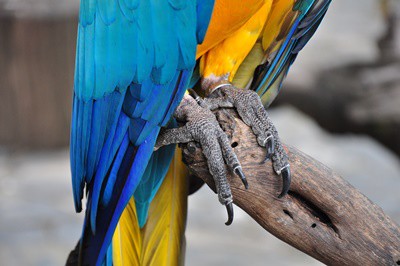
Parrots’ claws grow continuously, so they must wear them down by perching on abrasive surfaces. Unfortunately, pet parrots’ nails can grow too long, curly, and flaky.
No claw length is suitable for all parrots, but you can tell if it’s comfortable based on its movement. The parrot will have difficulty landing, perching, walking, grasping objects, and climbing.
You can take a parrot to the vet to have its nails cut or trim them at home. Once the claws have been clipped, various textured perches should be introduced to keep a parrot’s nails the right length.
Parrots Nails Too Long
There are over 400 species of parrots of all sizes, so there’s a range of claw lengths.
A parrot’s nails aren’t necessarily too long if they feel sharp. Parrots’ claws are meant to be pointy, giving them a better grip on food, perches, and objects. They’re all used as a means of defense.
If a parrot struggles with everyday activities like walking and standing, its claws may need trimming.
Signs of Overgrown Parrot Nails
If a parrot’s claws are overgrown, you’ll notice the following signs:
- Long, curly, or twisted claws. The claws should have a curve, but they shouldn’t curl back on themselves like a sheep’s horn.
- Flaky appearance. This is due to the shedding of layers of beta-keratin (β-keratin).
- Difficulty grasping objects. A parrot may struggle to pick up and position items.
- Perching behavior. You may notice the parrot prefers to stand on a flat surface, not a perch.
- Movement. Climbing and walking become uncomfortable.
- Overly sharp nails. The parrot will get its nails caught on toys, fabric, or cage bars.
According to The Royal Society, parrots scratch themselves with their feet to maintain their feathers and remove dirt and parasites. You may notice or feel cuts, abrasions, and scabs on the skin.

Why Parrots Bite Their Nails
Parrots bite at their nails when the length makes grasping and walking difficult.
There are other explanations. It may have a nervous habit triggered by anxiety or boredom. Also, parrots bite at their feet due to pain or itchiness caused by an infection or growth.
According to the Journal of Avian Medicine and Surgery, dermatitis can cause an itchy rash, which can lead to self-mutilation, such as chewing or biting at the feet.
How To Clip Parrot Nails
If a parrot doesn’t trust you, it won’t let you hold it still as you approach with the clippers.
For practical assistance, have a vet demonstrate how to perform the procedure. This is the safest way if the parrot has dark nails where it’s harder to see the quick.
To cut a parrot’s claws, follow these steps:
Gather Materials
You’ll need the following tools and materials:
- Towel. This is to wrap the parrot and keep it still.
- Clippers. Depending on the claw size, you can use dog clippers.
- Nail file. Parrots’ claws can be sharp after clipping, so some owners sand them down.
- Styptic powder (hemostatic powder). This is to stem the flow of blood.
Styptic powder will stop the bleeding if you cut a parrot’s quick (the blood vessels inside its nail). It contains astringents that cause the tissue to contract, sealing off the broken blood vessels.
VideoGIE stated that hemostatic powder is used in human surgeries to stop internal bleeding.
Some owners use a nail-grinding tool rather than clippers. This is similar to a Dremel polishing tool, but it’s intended for small animals.
Wrap The Parrot in A Towel
Claw clipping can be a terrifying experience because parrots don’t understand what you’re doing. Most birds will attempt to fly away. The easiest way to keep the parrot still is to wrap it in a towel.
Parrots fear bright-colored towels. Choose a light, neutral color, such as white, pale gray, or beige.
The towel doesn’t have to be thick but must be large enough to wrap around the densest part of the parrot’s body at least twice.
While holding the parrot still with one hand, wrap the towel around its body. Wrap it snugly so it can’t move its wings, but not so tightly that it causes discomfort or distress.
Ask a friend to assist if you’re finding the process difficult.
Parrots may find it easier to stay calm during a claw trim if they can’t see what’s happening. Some owners cover the parrot’s head and eyes with a towel but uncover the eyes if it stresses them.
Let The Parrot Grasp Your Hand
Once securely wrapped in a towel, sit with the parrot in your lap.
Lift the end of the towel so that its feet are exposed. Ensure your supplies (clippers, file, and styptic powder) are within easy reach.
You may have to tilt the parrot backward and let it rest against a cushion or the arm of the chair. If you have a friend with you, ask them to hold the parrot.
Let the parrot grasp your hand with its toes. Ideally, this should be your non-dominant hand.
The parrot should grasp your index finger so that your thumb remains free. That way, you can use your thumb to lift each of the toes one by one, making it easier to clip each nail.
Cut The Tip of Each Nail
The parrot is perched on your hand so you can start cutting its nails. At this point, the parrot may struggle to break free, so hold it securely.
Before you start cutting or filing, identify the quick. As mentioned, this is a blood vessel that runs through the center of the nail. If you accidentally cut the quick, the nail will start to bleed.
If a parrot has light-colored claws, you can see the quick through the nail. It looks like a red or pink vein.
If a parrot has dark or black claws, you may not see the quick. In this case, taking the parrot to a vet is safer than attempting the procedure yourself.
A parrot’s nails should still have a curve to assist with grasping objects.
Once you’ve finished, reward the parrot with a treat. That way, the parrot will associate having its nails clipped with a positive experience.

Parrot’s Nails Are Bleeding
If one of the parrot’s nails starts to bleed, you’ve cut the quick.
This means you’ve clipped too much of the nail off and opened up the blood vessels. The quick will bleed, and the parrot will lose blood.
If one of the parrot’s nails starts bleeding, follow this procedure:
- Pinch the toe to reduce blood flow to the nail. If possible, hold the parrot upside down.
- Dip the bleeding nail into styptic powder.
- Apply mild pressure to the damaged nail until the bleeding stops.
Once the wound has stopped bleeding, brush off the remaining powder. If the bleeding worsens, take the parrot to a vet to cauterize the wound and stem the blood flow.
How Often To Trim Parrot Nails
Parrots’ claws grow continuously, meaning they won’t stay short and blunt. Parrots’ claws grow at different rates based on their diet, activity level, and cage setup.
After cutting a parrot’s nails, you may initially notice it’s struggling to grasp, climb and balance. This may mean you’ve cut its claws too short, but an adjustment period is expected.
After a few days, the parrot will have learned how to grasp in light of its new nail length.
How To Keep A Parrot’s Nails Short
Some things keep a parrot’s claws short naturally, including:
- Tree branches. The rough texture will wear down the parrot’s nails.
- Pedi perches. These have a rough area to rest the claws on and stimulate healthy feet.
- Braided ropes. The abrasive texture of the rope wears away the excess nail.
If you use a pedi perch, leave it in the cage a few days a week. Avoid using sandpaper perches or perch covers because they can cause sores on the bottom of the feet, leading to bumblefoot.
Nail trimming can be stressful for parrots. After all, it’s not something they’d need or have done in the wild. Being physically restrained is uncomfortable and can induce panic.
If the parrot becomes agitated, stop trimming its nails and remain still for a few minutes. You may have more success using a nail file because the loud clipping noise can be startling.